
Redesigned Sedex's buyer dashboard for enterprise customers managing large supplier networks, improving data clarity and scannability across compliance and ESG workflows. Owned the widget system redesign and key UX/UI improvements that reduced time to complete core tasks by 30%.
Role: Product design · Research · Prototyping · Design system foundations · Delivery with Product & Engineering
Metrics
Summery
Sedex is a global membership organisation that helps businesses improve ethical and responsible practices in their supply chains. Through its platform and tools like SMETA audits, it enables companies to assess risks related to labor, safety, environment, and ethics, promoting transparency, compliance, and sustainability.
As Senior Product Designer at Sedex, I redesigned the buyer dashboard - the primary interface enterprise clients use to manage supply chain compliance across hundreds of supplier sites. I owned the widget system redesign, conducted user research that shaped the product direction, and designed key interface improvements that reduced task completion time by 30%.
Problem
The buyer dashboard, a critical interface for supply chain visibility, had become outdated and difficult to navigate as the platform scaled. The experience relied on dense information, inconsistent visual hierarchy, and limited guidance, making it hard for buyers to quickly invite suppliers, assess compliance status, or track ESG goals.
As supplier networks grew in size and complexity, buyers increasingly managed hundreds of sites across regions, amplifying issues around data clarity, prioritisation, and communication. This created friction in day-to-day workflows and reduced confidence in the dashboard as a decision-making tool.

Solution
Dashboard structure & core experience
Reworked the buyer dashboard information architecture and layout to reduce complexity and improve scannability across compliance, risk, and ESG workflows.
Widget system redesign
Redesigned the dashboard’s widget framework to support configurable modules with strong default states, enabling users to prioritise key metrics while maintaining clarity and usability.
Brand implementation
Played a key role in applying Sedex’s refreshed brand identity across the dashboard, contributing to updated colour usage, typography, and UI components to create a more cohesive and consistent product experience.
Component & interaction design
Designed and evolved a suite of reusable UI components, including interactive data visualisations, navigation patterns, and adaptive layouts to improve accessibility and engagement.
Research-led future concepts
Alongside the core redesign, explored and validated concepts for predictive weather and risk alerts, ESG goal-setting with predictive insights, and real-time buyer–supplier collaboration to inform future product direction.
User research & validation
Conducted in-depth qualitative research through interviews at Sedex’s annual conference, complemented by usability testing, A/B experiments, and analytics to validate design decisions and iterate toward clearer, more effective workflows.
Key Design Decisions & Trade-offs
Customisation vs clarity
Buyers wanted flexibility, but excessive choice increased cognitive load. The dashboard introduced configurable widgets with strong default states to balance personalisation and usability.Complex data vs scannability
High-level risk and compliance signals are surfaced first, with progressive disclosure into detailed views to support both quick scanning and deeper analysis.Buyer dashboard informed by supplier realities
While the dashboard was buyer-facing, research across supplier roles informed how data, alerts, and compliance status were presented to ensure accuracy and trust.

Process
Following a user-centric and agile approach, I ensured continuous validation and iteration of design choices:
Discovery Phase: Conducted UX research, competitor analysis, and stakeholder interviews to define pain points and opportunities.
User Testing & Validation: Utilised in-person interviews, moderated and unmoderated testing, and platforms like UserTesting.com to assess the existing dashboard and validate new designs.
Wireframing & Prototyping: Created interactive wireframes and prototypes, ensuring seamless user flows before development.
Cross-Functional Collaboration: Worked closely with product managers, engineers, and leadership teams, contributing strategic insights at board meetings to align UX with Sedex’s long-term vision.

Outcome
Clearer Product Vision & Strategy: Defined a long-term roadmap that aligned with Sedex’s mission of ethical supply chain visibility and operational resilience.
Innovation & Competitive Edge: Introduced cutting-edge features such as AI-powered risk prediction and real-time collaboration, positioning Sedex as an industry leader.
Stronger Brand Identity: Successfully implemented a refreshed brand experience with a modernised colour palette, typography, and UI elements that improved the platform’s overall aesthetic and usability.
More Intuitive UI Components: Designed and integrated new interface components to improve navigation, data representation, and overall user experience.
Scalable Future Vision: The redesign laid the groundwork for continuous improvements and feature expansion, aligning Sedex with emerging industry trends and technological advancements.
Through this project, I not only delivered immediate improvements to the platform but also shaped Sedex’s strategic vision for the future of ethical supply chain management. My work ensured that both current usability challenges and long-term scalability needs were met, reinforcing Sedex’s position as an industry leader.

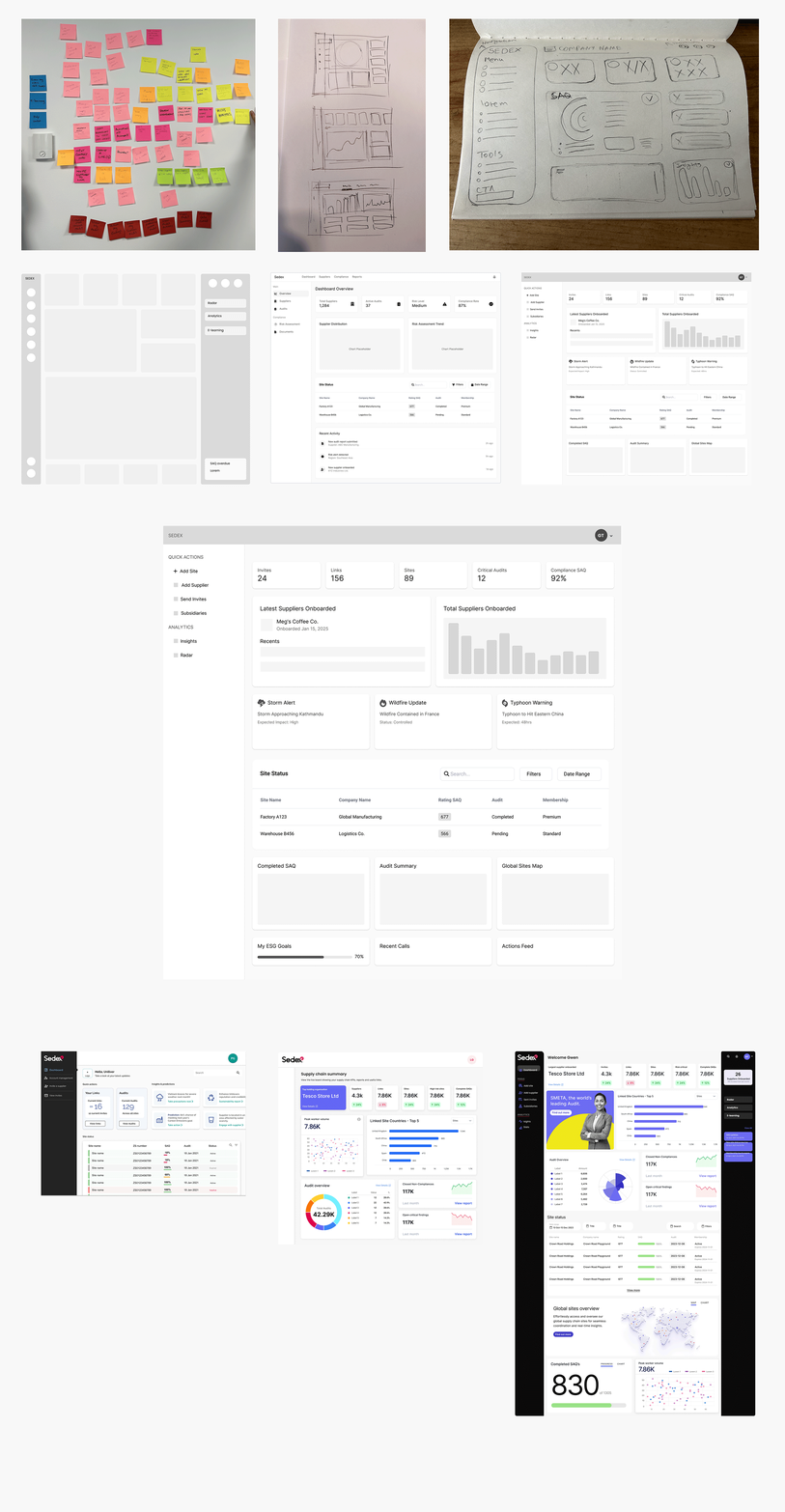
Design evolution
Creating the final dashboard design was a long, iterative process. We moved from brainstorming to wireframes and multiple design iterations, validating concepts at every stage. This involved speaking with users, stakeholders, and the technical team to ensure feasibility and usability. We leveraged every opportunity to gather insights: interviewing customers, attending expos, and participating in Sedex-organized events - to understand what features users wanted, identify pain points in existing designs, and explore ideas that could leverage cutting-edge technology. These insights directly shaped the dashboard’s design and informed its future vision
Delivery & Forward Vision
Delivered during my tenure
Buyer dashboard information architecture and layout redesign
Modular widget framework with configurable defaults
Rebrand implementation across dashboard and core components
Improvements to onboarding, account management, login, and payments
Vision defined and validated
Predictive weather and risk alert concepts
ESG goal modelling and AI-assisted insights
Real-time buyer - supplier collaboration features
I left before some of the longer-term features shipped, but I owned the dashboard redesign, the system foundations, and the vision work that shaped what came next. My focus was ensuring the work was validated, technically feasible, and ready to be picked up.
Role
User Experience (UX) & User Interface (UI) Designer, User Researcher, Product Strategy